Citizen Sailors by Glyn Prysor
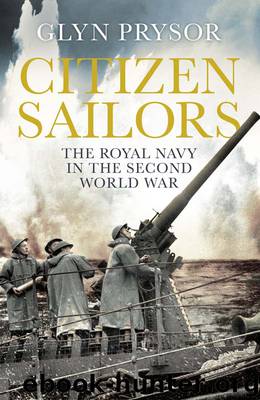
Author:Glyn Prysor [Prysor, Glyn]
Language: eng
Format: epub
ISBN: 9780141937618
Publisher: Penguin Books Ltd
Published: 2011-07-08T16:00:00+00:00
Throughout the spring of 1942, members of the public in towns and cities across Britain took part in the Warship Week campaign, orchestrated as part of the National Savings drive. Funds and gifts amounting to hundreds of millions of pounds were raised over the course of the war. Communities were given fund-raising targets which equated to the cost of ‘adopting’ a ship. Smaller towns might be allocated a destroyer; larger cities a battleship. Organizations also took part: HMS Warspite was supported by the London Stock Exchange. Sailors would receive gifts of luxuries, books, clothing or other items, once the link had been established. Some of the money raised was also set aside for local charities. Detachments of sailors might be sent to visit their adopters, posing for photographs and giving interviews to the local newspapers, attending parties for children and dances for adults.
HMS Orwell was adopted by Ipswich. Nineteen-year-old Midshipman Richard Campbell-Begg was particularly pleased when the townspeople donated a ‘sun-ray lamp’. ‘I sat under it for some ten minutes and came out as red as a beetroot and one mass of freckles,’ he wrote in his diary. ‘Now it is all peeling off so I am due another treatment.’ John McGregor, a radar operator in the battleship Duke of York, had managed to acquire a valuable memento during another of Winston Churchill’s voyages across the Atlantic in December 1941: ‘One of his cigar ends, which some months later I sent to the Ilford Council for their Warships Week and over £400 was realized on it.’
It was not only government programmes which brought sailors and civilians together. Personal relationships could flourish if a ship remained in one place for some time. When HMS Salamander was based at Rosyth, Vincent Shackleton befriended a local artisan known as ‘Jock’ Hutton who had two young daughters. One of them suffered from polio and was confined to a wheelchair. Shackleton and his messmates ‘adopted’ her, taking her to watch her beloved Dunfermline Athletic and escorting her on afternoons out. Long-distance relationships were also possible. Aside from their normal correspondence with family and friends, sailors might receive letters from schoolchildren or gifts from members of the Women’s Institute. Many female factory workers were eager to acquire pen-pals. One matelot reminisced that ‘we had packs of cigarettes from South Africa containing at times young ladies’ photos and addresses’. Others found notes secreted inside their life jackets by factory workers with messages such as: ‘May this save the life of a Sailor. God bless you.’
An emotional link between sailors and civilians was at the heart of the Atlantic enterprise. At the beginning of the war, Frank Layard had felt guilty about remaining at his desk while his peers returned to sea. By 1942 he was commanding the destroyer HMS Firedrake in the Atlantic. Yet he remained as emotionally engaged with developments at home as those abroad. ‘It was announced on the news that there had been a combined raid on St Nazaire by the Navy, Army and R.
Download
This site does not store any files on its server. We only index and link to content provided by other sites. Please contact the content providers to delete copyright contents if any and email us, we'll remove relevant links or contents immediately.
| Africa | Americas |
| Arctic & Antarctica | Asia |
| Australia & Oceania | Europe |
| Middle East | Russia |
| United States | World |
| Ancient Civilizations | Military |
| Historical Study & Educational Resources |
The Radium Girls by Kate Moore(12035)
100 Deadly Skills by Clint Emerson(4931)
Rise and Kill First by Ronen Bergman(4797)
The Templars by Dan Jones(4695)
The Doomsday Machine by Daniel Ellsberg(4493)
The Rape of Nanking by Iris Chang(4224)
Killing England by Bill O'Reilly(4008)
Stalin by Stephen Kotkin(3973)
Hitler in Los Angeles by Steven J. Ross(3949)
12 Strong by Doug Stanton(3554)
Hitler's Monsters by Eric Kurlander(3348)
Blood and Sand by Alex Von Tunzelmann(3207)
The Code Book by Simon Singh(3197)
Darkest Hour by Anthony McCarten(3135)
The Art of War Visualized by Jessica Hagy(3014)
Hitler's Flying Saucers: A Guide to German Flying Discs of the Second World War by Stevens Henry(2758)
Babylon's Ark by Lawrence Anthony(2685)
The Second World Wars by Victor Davis Hanson(2529)
Tobruk by Peter Fitzsimons(2521)
